Matt Farnham
One of the simplest communication frameworks I use with teams is also one of the most effective.
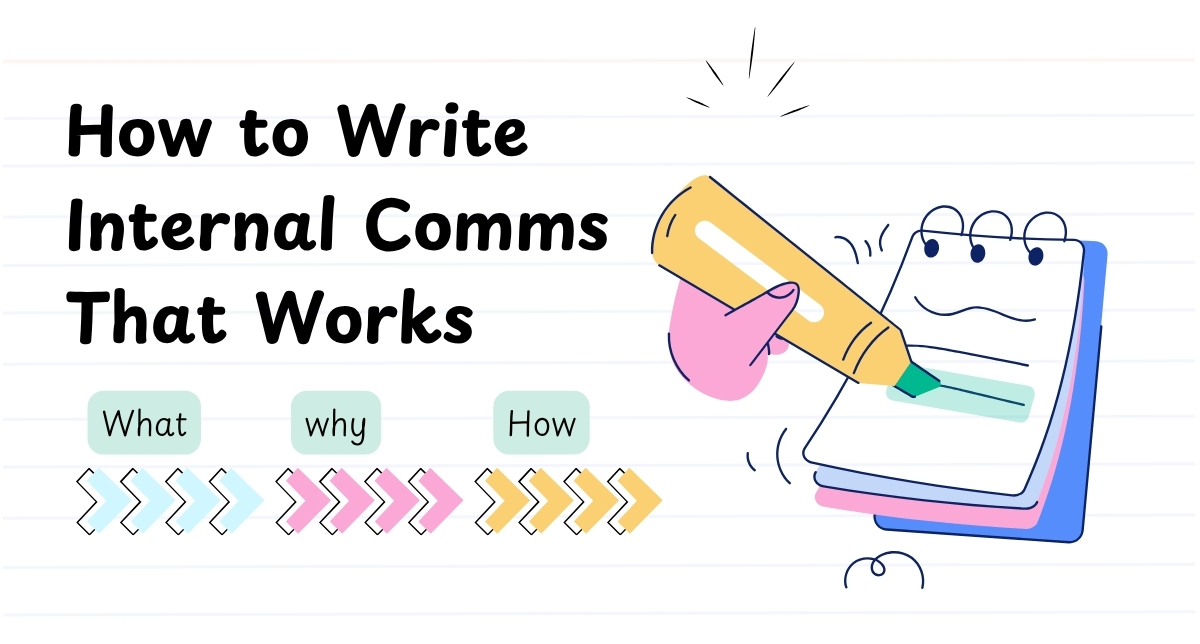
When communicating change internally, I structure messaging around three core questions:
- What has changed?
- Why has it changed?
- How do people need to act?
It is simple, but it is grounded in how people actually process uncertainty and behavioural change.
A surprising amount of internal communication misses at least one of these steps. Usually the “how”.
Organisations often communicate change as an announcement rather than a behaviour shift. They explain the update. They explain the strategy. They explain the rationale.
But employees are still left asking:
“What does this actually mean for me tomorrow morning?”
That gap matters more than many leaders realise.
Research consistently shows that uncertainty during organisational change increases resistance, disengagement and confusion, particularly when employees do not understand either the purpose of the change or their role within it.
Internal communication is not just information distribution
One of the biggest mistakes organisations make is assuming communication equals understanding.
Sending an email is not the same as creating clarity.
A polished intranet article is not the same as behavioural adoption.
Research from the McKinsey & Company has repeatedly found that transformation programs are significantly more likely to succeed when organisations communicate clearly, consistently and behaviourally throughout change processes. Employees need both rational understanding and practical direction.
At the same time, studies in organisational psychology have long shown that people respond better to change when uncertainty is reduced and expectations are clear. Ambiguity creates stress. Clarity creates confidence.
That is why I keep returning to three core questions.
1. What has changed?
This is the factual layer.
What is different from before?
Research in cognitive psychology suggests people process information more effectively when communication is clear, structured and easy to mentally organise. If employees cannot quickly understand what is changing, they will struggle to absorb the rest of the message.
Yet many organisations overcomplicate this section with corporate language, excessive context or strategy jargon.
People should not need to decode the announcement.
A good test is whether someone can explain the change back to another person in one sentence.
If they cannot, the communication is probably too vague.
2. Why has it changed?
This is the trust layer.
People are far more likely to support change when they understand the reasoning behind it.
Research from Prosci consistently identifies awareness of the business reasons for change as one of the strongest predictors of successful adoption. Employees want context before commitment.
The “why” answers questions like:
- Why now?
- What problem are we solving?
- Why is this better?
- Why should employees care?
Without this layer, change can feel arbitrary or disconnected from reality.
This is especially important during technology transformations, restructures or process changes. If people do not understand the purpose behind a decision, they often create their own explanation, and that explanation is rarely positive.
The best organisations communicate the rationale in plain language.
Not spin.
Not buzzwords.
Not “transformation journey” language.
Just honest context.
3. How do people need to act?
This is the behavioural layer, and in my experience, the most overlooked part of internal communication.
Every change communication should answer:
“What do you need me to do differently?”
Behavioural science research has consistently shown that people are more likely to adopt new behaviours when expectations are specific, observable and actionable.
That action might involve:
- changing a process
- using a new system
- speaking to customers differently
- escalating issues differently
- adopting a new compliance step
- working in a new way
If employees finish reading a communication without understanding the practical expectation, the communication has probably failed.
This section should be concrete and specific.
Not:
“Continue delivering excellent customer outcomes.”
Instead:
“From Monday, all customer applications must be submitted through the new workflow.”
Clarity drives adoption.
Why this framework works
I like this structure because it aligns with how people naturally process change.
Humans instinctively try to answer:
- What is happening?
- Why is this happening?
- What do I do now?
Good communication reduces cognitive load by answering those questions directly.
It also creates alignment between leadership intent and frontline execution.
That matters because most organisational change does not fail due to strategy alone. It fails in the translation layer between decision-making and day-to-day behaviour.
Internal communication sits directly in that gap.
The bigger lesson
The best communicators are not necessarily the most polished writers.
They are the people who create clarity.
In marketing, PR and external communications, we often talk about audience understanding and simplicity. The same principles apply internally.
Employees are audiences too.
And during periods of change, clarity becomes one of the most valuable things leadership can provide.