Matt Farnham
AI search has been described by McKinsey as the “new front door to the internet” (1). There’s been plenty of rhetoric that SEO is dead and GEO has replaced it, which isn’t true, it’s updated it. AI search doesn’t simply retrieve brands, it interprets them, summarises them and determines which signals are credible enough to include.
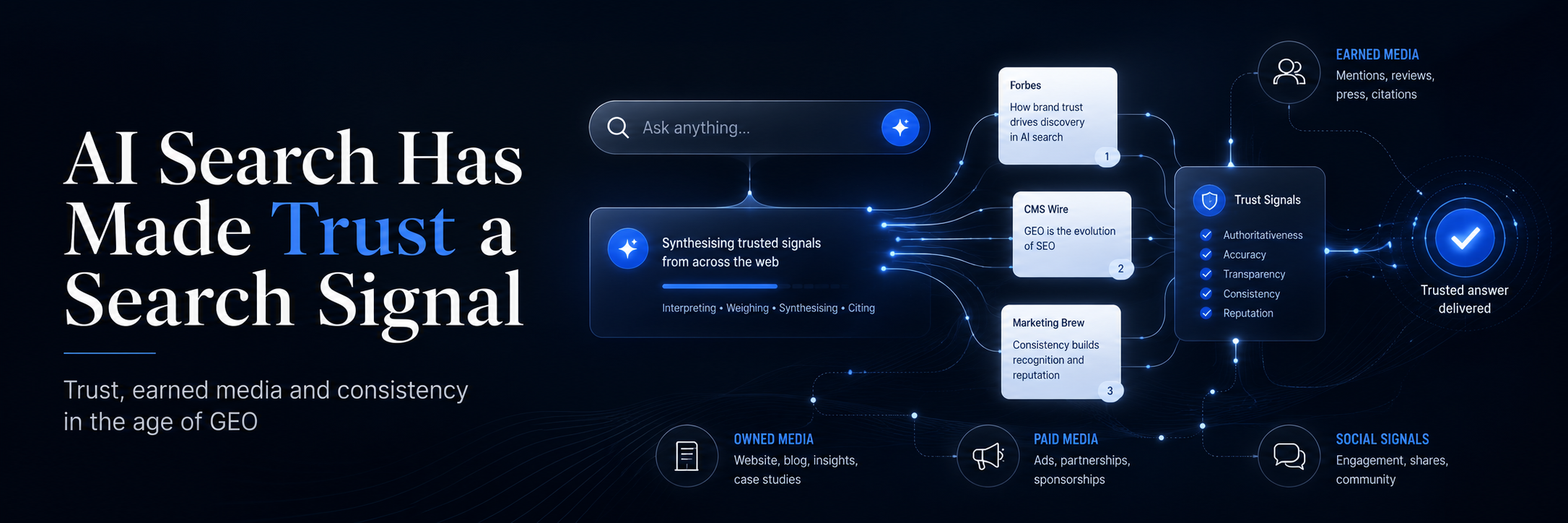
If AI search becomes a primary way people discover, compare and evaluate brands, then generative engine optimisation isn’t just a technical marketing challenge. It’s a trust challenge. GEO doesn’t replace SEO, PR, brand or communications. It highlights the need for them to work together more deliberately.
The brands most likely to appear in AI-generated responses won’t just be the most active or best optimised. They’ll be the ones that are clearly understood, consistent in how they show up, and supported by trusted signals. What you say on your website (what you say about yourself) might matter less than what others say about you.
This is where earned media becomes more important.
Research into AI search suggests generative engines rely heavily on third-party sources, including publisher sites, expert commentary and independent reviews, when forming responses (2). In effect, what others credibly say about a brand can materially impact whether AI lists you at all.
This reframes the role of PR
Earned media is no longer just coverage. In an AI search environment, it becomes part of the evidence around a brand. The original academic research on Generative Engine Optimisation found that GEO techniques could improve visibility in generative responses by up to 40 per cent (3). That’s significant, but the more important takeaway is how visibility itself is changing.
Traditional search prioritised relevance and authority. AI search introduces another layer: interpretation. It needs to determine what a brand is, what it’s known for, whether the signals are consistent, and whether they’re credible enough to include.
This effectively turns trust into a search asset.
Consistency becomes one too. Paid, Earned and Owned each still serve their purpose; GEO is just making the relationship between them more visible. Owned content still gives brands a source of truth. Paid media still helps create attention and demand. But earned media may become even more important because it gives generative engines something brands cannot create for themselves: credible third-party context.
Search Engine Land describes paid, earned, shared and owned media as all shaping generative search visibility, which feels like the right way to think about the shift (4). Owned media helps define what the brand wants to be known for. Earned media helps validate that story through credible external sources. Paid media helps create demand, repetition and visibility around the same ideas.
In a GEO environment, the strongest brands will be the ones with the clearest and most consistent signals around them. If a website says one thing, media coverage suggests another, leadership uses different language, and campaigns shift direction, the result is noise and AI will cut through it.
That inconsistency has always been a brand issue. AI search simply makes it more visible. It shouldn’t sit in a technical silo, it sits alongside brand strategy, PR, content, customer experience and reputation.
A more useful question than “Are we optimised for AI?” is: When a potential customer asks AI about us, what will AI say?
And then:
- Would that answer be accurate?
- Is that how we want to be seen?
- Does this align with our brand strategy?
If any of those are no, then you’ve got some work to do on your whole marcoms ecosystem (not just updating your website copy). These questions are especially important in high-trust categories like banking, insurance, superannuation, health and financial advice. In these sectors, people aren’t just looking for information. They’re looking for confidence, signals that a brand is credible, established and safe.
The fundamentals haven’t changed, there’s just nowhere to hide. What’s changing is how those signals are connected. The future of search will favour brands that aren’t just easy to find, but easy to understand, credible enough to believe, and consistent enough for AI to recommend. I’ve written before about what marketers need to consider with trust becoming more important to consumer choice, read it here.
The GEO Brand Audit
Try this, and let me know whether you like what you find.
Brand Interpretation Audit prompt
Act as an independent AI search and brand strategy analyst.
I want you to assess how my brand is likely to be understood, summarised and recommended in AI search environments such as ChatGPT, Gemini, Perplexity and Google AI Overviews.
Do not treat this as a traditional SEO audit. Treat it as a brand interpretation audit.
Your task is to assess whether the brand is clear, credible, consistent and easy for AI systems to understand.
Brand: [insert brand name]
Website: [insert website]
Category: [insert category]
Market: [insert country or region]
Key competitors: [insert 3 to 5 competitors]
Target audience: [insert audience]
What we want to be known for: [insert intended positioning]
Please analyse the brand across owned, earned and paid signals.
Assess:
- What the brand appears to be known for
- Whether that matches what the brand wants to be known for
- How clearly the brand is positioned
- What trust signals are visible
- What third-party credibility signals exist
- Whether owned media, earned media and paid media appear to tell the same story
- What customer questions this brand is likely to appear for
- What customer questions competitors may appear for instead
- Where the brand signal is unclear, thin or inconsistent
- What an AI-generated answer would likely say about the brand today
Then provide:
- A likely AI summary of the brand
- The strongest trust signals
- The weakest or missing trust signals
- Owned media assessment
- Earned media assessment
- Paid media assessment
- Competitor risks
- Brand consistency score out of 10
- Trust signal score out of 10
- GEO readiness score out of 10
- Top 5 actions to make the brand clearer, more credible and easier to recommend
- One sentence diagnosis
Be direct, specific and critical. Do not give generic advice. Focus on what would help AI systems and potential customers understand, trust and remember the brand.

Matt Farnham is an award-winning senior marketing leader with more than a decade of experience in brand, communications and customer engagement. His work has focused on helping organisations build trust, strengthen customer relationships and drive sustainable growth, particularly in highly regulated industries. In 2024, he was named Future Leader of the Year at the Australian Marketing Institute Marketing Excellence Awards. He writes about brand strategy, marketing effectiveness and customer behaviour at mattfarnham.au.
References
McKinsey & Company, 2025, New front door to the internet: Winning in the age of AI search, https://www.mckinsey.com/capabilities/growth-marketing-and-sales/our-insights/new-front-door-to-the-internet-winning-in-the-age-of-ai-search
Britopian, 2025, Earned Media Dominates AI Search: The 2025 AI Search Source Bias Study, https://www.britopian.com/research/earned-media-dominates-ai-search/
Princeton University, 2024, GEO: Generative Engine Optimization, https://collaborate.princeton.edu/en/publications/geo-generative-engine-optimization/
Search Engine Land, 2025, How paid, earned, shared, and owned media shape generative search visibility, https://searchengineland.com/paid-earned-shared-owned-media-generative-search-visibility-465603