Matt Farnham
Why being highly recognisable can make a trust problem harder to bounce back from
Telstra was already in that position before its nationwide outage on 8 July 2026.
Brand awareness is usually treated as an uncomplicated advantage. The more people who know a brand, the greater its chance of being noticed, remembered and considered. For many marketers, growing awareness remains one of the central objectives of brand investment.
A company can be widely known, immediately recognisable and deeply embedded in public memory while also being distrusted. In that position, awareness stops being an uncomplicated commercial advantage. It ensures every failure has an existing audience, every negative experience can be attributed to the right company and every new incident reconnects with what people already believe.
Roy Morgan ranked Telstra as Australia’s eighth most distrusted brand in late 2025. Its distrust was being driven largely by pricing and service issues, while Optus was carrying longer-term damage from repeated failures. Telecommunications subsequently became Australia’s most distrusted industry in the 12 months to December 2025 (1, 2).
The latest outage gave Australians another significant failure to attach to a brand they already knew well and many already questioned.
More than 600 Triple Zero calls were blocked during the outage, while businesses and transport networks were also disrupted. Telstra will now appear before a Senate inquiry, alongside its own internal investigation, an ACMA investigation and a post-incident review by the Triple Zero Custodian (3).
The reported cause was unusually memorable. A software defect caused part of Telstra’s network to behave as though the date had returned to November 2006, disrupting the time synchronisation and authentication systems on which the network depended (4).
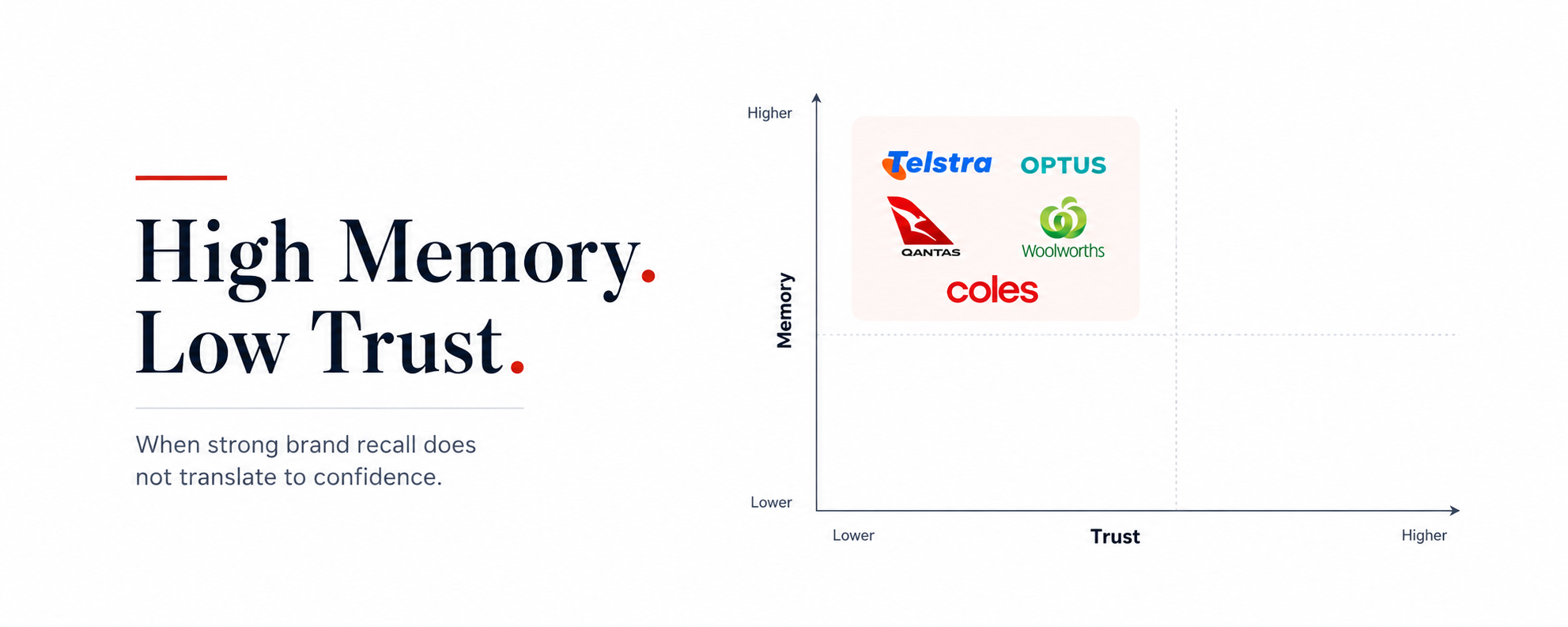
Telstra sits squarely in high-memory, low-trust. This is the combination where a brand remains highly visible, distinctive and easy to retrieve, while the meaning attached to it deteriorates.
But recognition no longer reliably retrieves confidence. It retrieves doubt.
Awareness isn’t evidence of brand health
Marketing often measures awareness as though being known is proof that the brand is strong. It isn’t. A familiar brand has an advantage because customers do not have to learn its name, category or relevance from scratch. New information attaches quickly to what is already stored.
When the brand is distrusted, the same memory system behaves differently. A new failure can retrieve previous service frustrations, pricing complaints, unresolved incidents, executive mistakes or a broader belief that the company does not reliably act in customers’ interests.
This is why a brand can continue posting strong awareness, reach and recall numbers while becoming less persuasive. The dashboard may show that people know the brand. It may not show that what they know has become the problem.
Awareness measures whether the brand is present in memory. It does not tell you whether that memory is helping.
In Make It Unmistakable 2026, Telstra appears among Australia’s top 10 home-grown unmistakable brand assets, alongside Bunnings, Westpac, Woolworths, Commonwealth Bank, Officeworks, Coles, Optus, Qantas and the ABC (5). Telstra is not simply widely known. It has built a brand system Australians can recognise and correctly attribute with ease. Its name, orange identity, advertising, stores, infrastructure and repeated presence in everyday life have accumulated over decades. Telstra does not have a recognition problem.
The trust problem remains
Correct attribution works in both directions. When the customer experience is good, people know which brand deserves the credit. When the experience fails, they also know exactly where to place the blame.
Distinctiveness reduces misattribution. For a distrusted brand, that means the failure lands exactly where it should. Telstra’s distinctive assets have not stopped functioning because the brand is distrusted. They remain highly effective. The issue is what those assets now retrieve.
Telstra’s orange identity, name and scale may still communicate familiarity and reach. They can also retrieve pricing frustration, poor service, network vulnerability and now a national outage that blocked emergency calls.
Memory is not inherently positive. It amplifies what the brand has given people to remember.
Brands with this high memory, low trust combination
Telstra and Optus are not outliers, and this is not only a telecommunications problem. Five of Australia’s 10 strongest home-grown brand assets belong to companies that also appear among the country’s most distrusted: Woolworths, Coles, Optus, Telstra and Qantas.
Recognition does not cause distrust. It makes that distrust easier to attribute, store and retrieve.
The commercial risk is not that these brands will be forgotten. It is that they will be remembered for the wrong reasons.
Brand | Evidence of high memory | Evidence of low trust |
Optus | Top 10 unmistakable asset and identified as one of the strongest connected asset systems | Australia’s most distrusted brand in the relevant Roy Morgan period |
Telstra | Top 10 unmistakable home-grown asset | Eighth most distrusted brand before the July 2026 outage |
Qantas | Top 10 unmistakable home-grown asset | Appeared among Roy Morgan’s most distrusted brands |
Woolworths | Top 10 unmistakable home-grown asset | Appeared among the top 10 most distrusted brands |
Coles | Top 10 unmistakable home-grown asset | Appeared among the top 10 most distrusted brands |
The old crisis playbook isn’t a trust strategy
The corporate response to a trust failure has become predictable. Issue the apology. Put an executive in front of a camera. Commission a review. Launch a campaign about listening. Repeat the word “customers” until the news cycle moves on. It is a well-rehearsed communications sequence. Some of it is necessary. None of it repairs trust on its own.
Trust does not sit in the apology, the campaign or the media plan. It sits in whether the failure happens again, whether customers are treated fairly and whether the organisation can produce evidence that its behaviour has changed.
Until then, reassurance is just another claim from a brand people already have reason to doubt. An apology may be necessary, but it is not evidence that the problem has been fixed.
A reassurance campaign asks people to accept another promise from the same organisation whose previous promise has failed. When the source itself is distrusted, greater message frequency does not automatically create greater belief. It may even sharpen the contradiction if customers continue encountering the same problems.
The first marketing question shouldn’t be:
How do we change the story?
It should be:
What must materially change before we have permission to tell a different story?
How a brand gets out of the distrust quadrant
The challenge is to make recognition valuable again. The way out is not to suppress memory, abandon established assets or try to overwhelm distrust with more media.
The way forward is to create credible behavioural proof, then use the existing brand system to make that proof easy to attribute and retrieve.
Fix the reason for distrust, not just the latest incident
An outage may trigger the crisis, but customers may interpret it through years of concerns about service, pricing, competence or accountability. Repairing the software issue will not repair trust if the underlying reasons for distrust remain intact.
The organisation needs to understand what the failure confirms in customers’ minds, whether that is weak competence, poor investment, inadequate accountability or a broader belief that customers are being taken for granted.
The operational response must give customers evidence that those beliefs no longer reflect how the organisation operates. That may include new safeguards, stronger testing, independent oversight, clearer escalation processes, automatic compensation, executive accountability or changes to the systems and incentives that allowed the failure to occur.
Marketing cannot manufacture these conditions. But marketing leaders should be close enough to the response to challenge whether the organisation has created anything meaningful to communicate.
Turn the repair into proof
Once change has occurred, the next task is to make it observable.
There is a difference between a reassurance claim and a proof point.
“We are committed to reliability” is a claim.
“We replaced the failed system, introduced independent testing and will publish the results” is evidence.
Specificity matters because distrust makes audiences more resistant to corporate messaging. Broad language about listening, learning and caring rarely changes a judgement formed through experience.
The proof should answer what failed, what changed, who is accountable and how customers will know the problem is less likely to happen again. Trust cannot be claimed into existence. It has to be earned, reinforced and made visible.
Attach the proof to the brand
Operational change alone does not guarantee brand recovery. People also need to know which company made the change.
This is where strong memory can become an advantage again.
Telstra already owns recognisable assets and substantial mental availability. It should use that established system consistently when communicating evidence of improved reliability, accountability and customer treatment.
The familiar cues should not disappear. They should begin carrying better proof. This is how recognisability becomes a commercial asset again.
Commonwealth Bank offers a useful contrast. Its recent trust recovery was supported by visible investment in customer safety. In FY25, CBA said it invested more than $900 million in protection from fraud, scams, cyber threats and financial crime, while reporting customer scam losses had fallen by more than 76 per cent from their peak (6). These were concrete responses to a customer concern where trust directly affects choice, not simply claims that the bank cared.
Trust needs proof. Memory needs attribution.
Proof without attribution can disappear into the news cycle or improve perceptions of the category rather than the company. Attribution without proof simply reminds people of the problem.
A recovery needs both.
What marketers should do to rebuild brand trust
Trust recovery has to be experienced, not just communicated. Marketing can explain what changed, but customer service, compensation, product performance and frontline behaviour have to prove it. The task is to identify which forms of evidence the brand can genuinely support, then make them visible and memorable.
Trust driver | What customers need to see | What marketers can do | What does not substitute for it |
Consistent behavioural delivery | The brand does what it says, repeatedly | Turn real service and product performance into visible proof | A new brand promise |
Reliability and competence | Products work, systems hold up and problems are resolved properly | Show measurable outcomes, service standards and improvements | Generic claims about being dependable |
Transparency | Clear explanations of what happened, what changed and what customers can expect | Translate complex operational information into plain language | Statements designed to avoid responsibility |
Accountability | Someone owns the outcome and consequences follow failure | Make responsibilities, reviews and corrective actions visible | An executive apology without demonstrable action or changes |
Fair customer treatment | Customers are compensated, supported and not made to carry the burden of the failure | Design simple remediation and communicate it clearly | An apology without restitution |
Consistency between promise and delivery | The customer experience matches the advertising | Test campaign claims against frontline and product reality | Advertising that outruns the experience |
Visible proof | Specific evidence that the organisation has changed | Use data, milestones, customer outcomes and verifiable actions | “We have listened” or “customers come first” |
Strong customer service | Help is accessible, human and effective when something goes wrong | Treat service interactions as part of the brand recovery plan | Customer-care imagery in advertising |
Independent validation | Credible third parties confirm the change | Use genuinely independent auditors, experts and customer advocates where appropriate | Paid endorsement without scrutiny |
Demonstrated safety and risk control | Risks are understood, managed and reduced | Make safeguards and protections visible and understandable | Vague language about safety |
Repeated evidence over time | Improvement continues after the news cycle ends | Keep attaching proof to consistent brand cues | A one-off reassurance campaign |
When memory starts working against the brand
Telstra did not enter this position because of one outage. It was already a highly recognisable and significantly distrusted brand. The July failure adds another powerful association to that existing structure.
The task is to change what that awareness is worth.
Memory gets a brand considered. Trust gets a brand chosen. But when trust collapses, memory makes the reasons not to choose it much easier to retrieve.

Matt Farnham is an award-winning senior marketing leader with more than a decade of experience in brand, communications and customer engagement. His work has focused on helping organisations build trust, strengthen customer relationships and drive sustainable growth, particularly in highly regulated industries. In 2024, he was named Future Leader of the Year at the Australian Marketing Institute Marketing Excellence Awards. He writes about brand strategy, marketing effectiveness and customer behaviour at mattfarnham.au.
References
- Roy Morgan: Trust in banking and finance industries, including all big four banks, increases significantly over the last 12 months https://www.roymorgan.com/findings/10052-roy-morgan-trusted-industries-and-brands-in-banking-and-finance-october-2025
- Roy Morgan: Bunnings is Australia’s most trusted brand; OpenAI enters the top 20 most distrusted brands for the first time https://www.roymorgan.com/findings/10247-risk-monitor-quartely-update-march-2026
- ABC: Telstra will face Senate inquiry after nationwide outage https://www.abc.net.au/news/2026-07-11/telstra-to-appear-before-senate-inquiry-after-nationwide-outage/106905204
- The Guardian: How a throwback to 2006 took down Telstra’s national phone network https://www.theguardian.com/australia-news/2026/jul/10/2006-throwback-took-down-telstra-national-phone-networ
- Principals and The Navigators: Make it Unmistakable 2026 Report https://www.principals.com.au/trend-presentation/make-it-unmistakable-2026-report/
- Commonwealth Bank: 2025 Full Year Results Presentation https://www.commbank.com.au/content/dam/commbank-assets/investors/docs/results/fy25/full-year-profit-presentation.pdf