 Matt Farnham
The Trust-Memory Framework: Why Being Remembered Isn't Enough
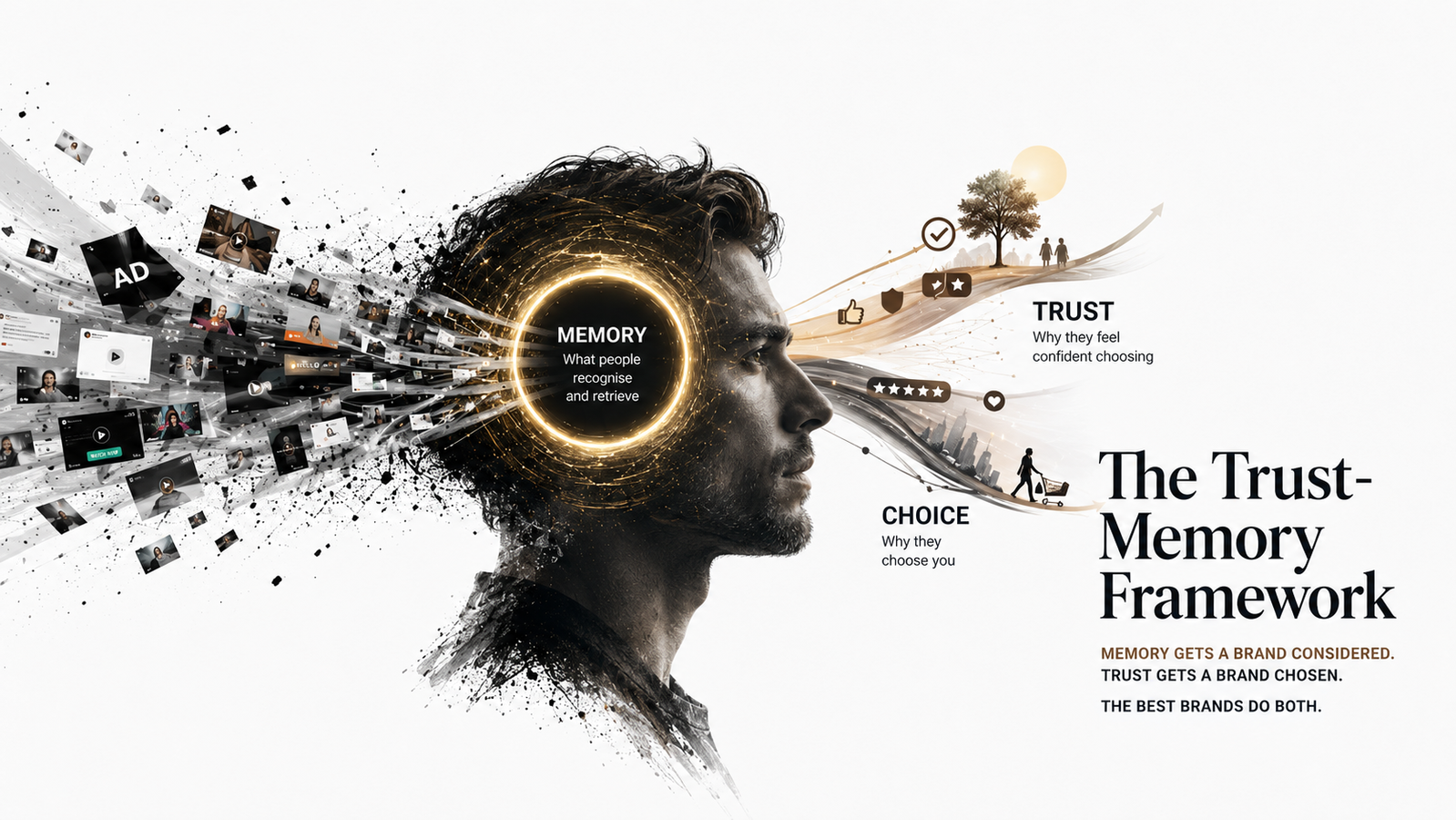
Memory is an amplifier. Trust determines what it amplifies.
The future of brand-building will not be won by the brands that create the most content. It will be won by the brands that know what to keep repeating, and what those repeated signals make people feel.
We have never had more ways to reach people, more tools to produce assets, or more data to optimise activity. Marketing systems are getting faster. AI has made it easier to create endless variations, and the pressure to refresh, adapt and test is constant.
But brand strength does not come from the amount of content a brand can produce. It comes from what customers retain. A brand can be seen everywhere and still fail to be remembered. It can be remembered and still fail to be trusted. It can be trusted by the people who know it, but MIA when decision is made.
That is the problem I am looking at with the Trust-Memory Framework.
Memory gets a brand considered. Trust gets a brand chosen. The best brands do both.
I have always worked in environments where trust matters. Banks, financial products and other high-consideration categories tend to involve uncertainty. People are making decisions that affect their money, homes, future security or family wellbeing. Over time, I noticed something that kept coming up. When people talked about brands they trusted, they often used the language of familiarity. They had seen the brand before. They had heard of it. It felt known. It felt established. It felt like a safer choice.
Memory and Trust are not the same thing, but they both contribute to brand growth in a way that compounds over time.
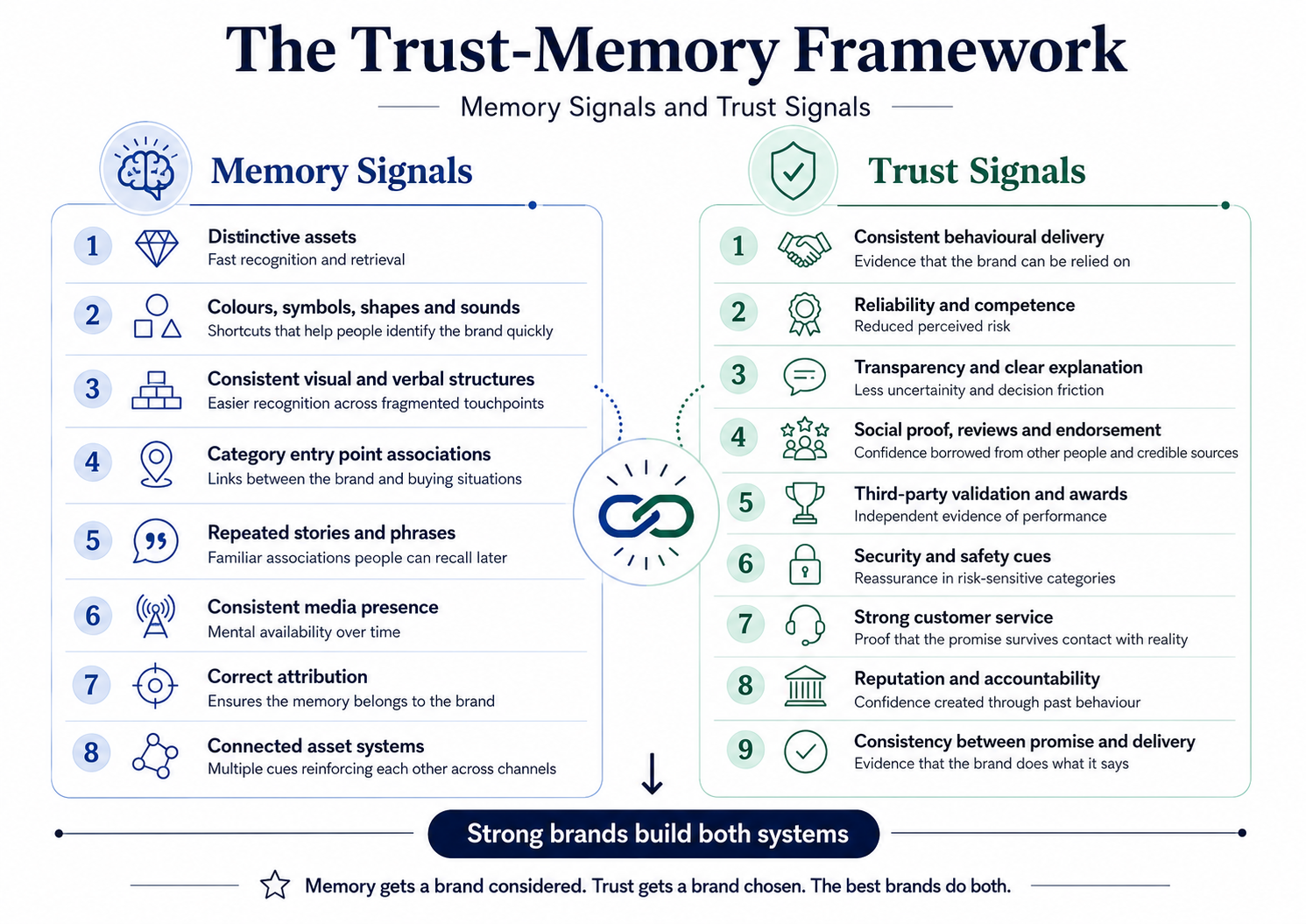
Memory is usually treated as the job of advertising, media and distinctive assets. Trust is usually treated as the job of reputation, service, proof, customer experience and delivery.
Customers do not experience brands in those neat internal silos. When someone makes a choice, they are usually asking two questions at once.
- Do I remember this brand?
- And do I trust it?
To win, the answer to both needs to be yes.
Attention is not enough
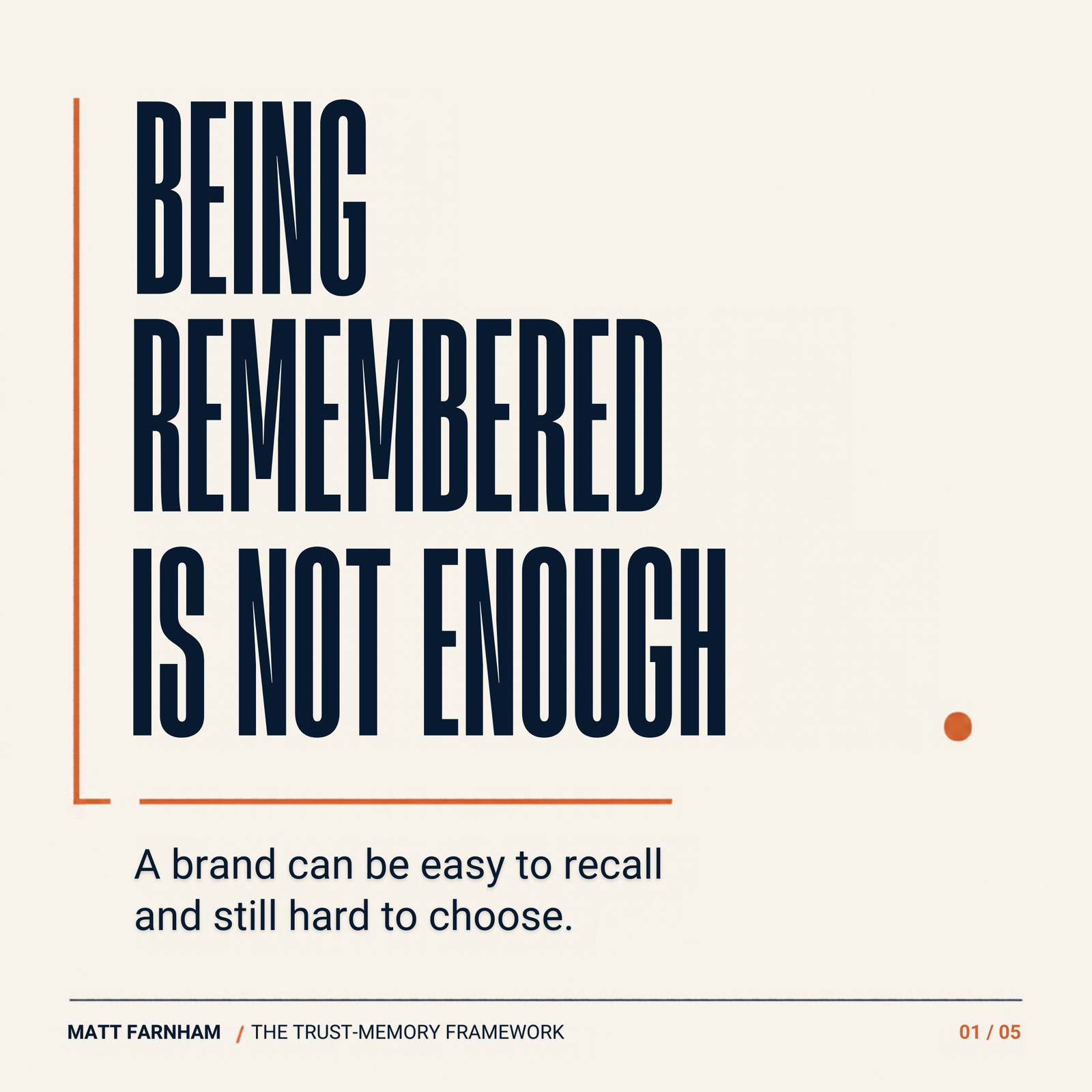
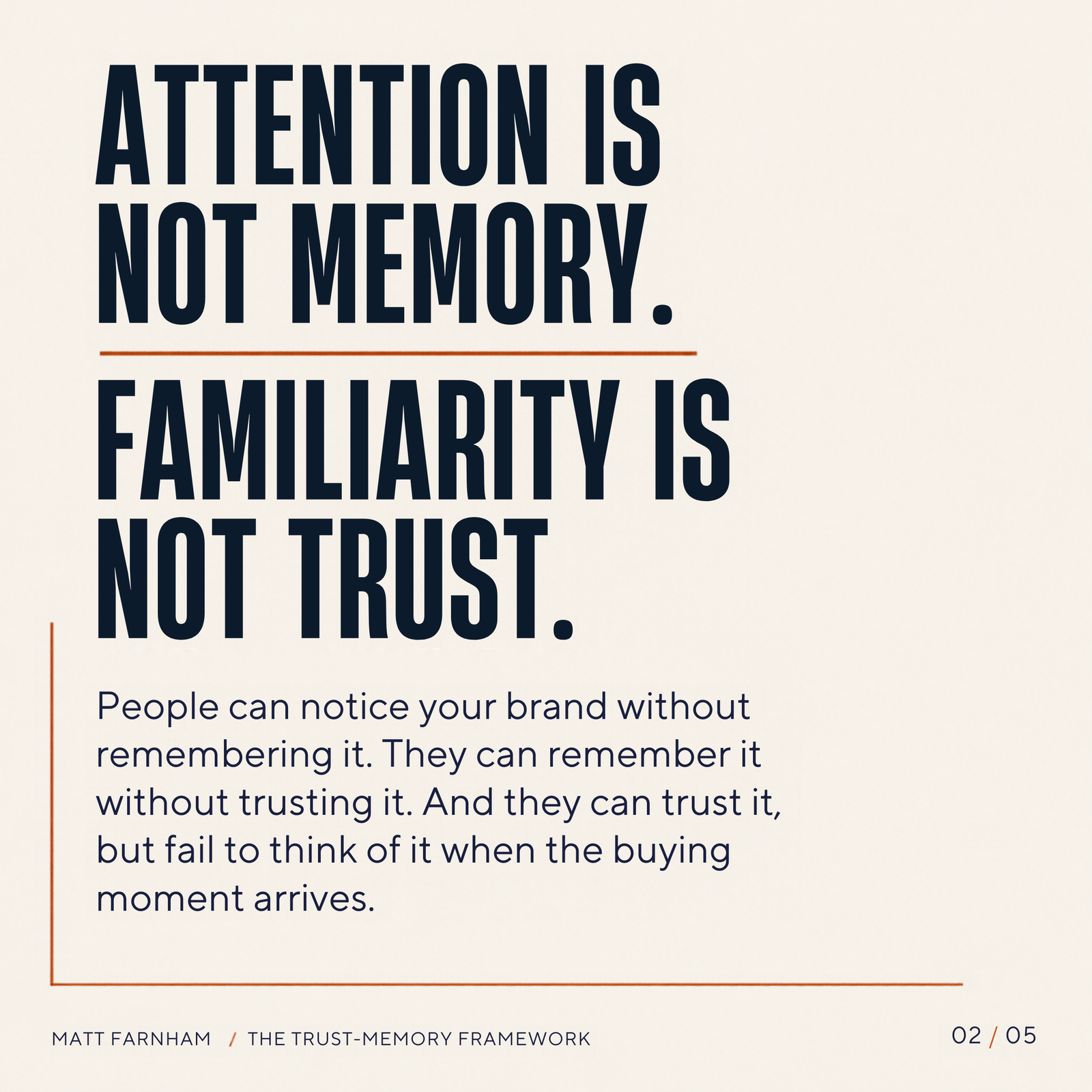
We can measure impressions, reach, clicks, views, watch time, engagement, completion rates and response. These metrics are useful. They tell us whether someone had an opportunity to notice something. Modern marketing has become very good at generating attention. But attention is not memory.
A person can stop scrolling, watch an ad, tap a post or click a link without forming any lasting memory of the brand behind it. They can enjoy the creative and forget the sender. They can remember the feeling and misattribute the brand. They can notice the work without the work leaving anything useful behind.
Modern marketing systems optimise for exposure, not necessarily for what remains after the exposure has passed.
For a long time, many brands benefited from media conditions that made memory easier to build. Large audiences watched the same television programs, listened to the same radio stations and saw the same campaigns repeated in relatively stable environments.
Those conditions have changed.
Australians now move across a more fragmented media environment. ACMA reports that almost all Australian adults use communication or social media websites and apps, with an average of 5.5 platforms used over six months. Australians are also using more internet-connected devices, with the average rising to 4.1 device types in 2025 (1). Video, audio, social, search, messaging and entertainment are spread across more screens, services and contexts than before.
That creates a harder memory problem for brands.
Attention is no longer concentrated. It is scattered across feeds, platforms, devices, creators, formats and content environments. I saw this play out in the 2025 season of Big Brother, where audiences experienced the show across multiple platforms, not just the ones the brand controlled.
Brands can still buy reach, generate impressions and create moments. The real challenge is whether those moments become memory. In fragmented environments, memory has to work harder. It has to survive partial exposure. It has to be recognised quickly. It has to be correctly attributed. It has to attach to the brand that paid for it.
Otherwise, marketing becomes a very expensive way of creating vague familiarity for the category, or worse, for a competitor.
Why Memory Matters
Byron Sharp’s work in How Brands Grow argues that brands grow by increasing physical and mental availability (2). Physical availability is about being easy to buy. Mental availability is about being easy to think of in buying situations.
That second idea is critical because brands are not chosen from nothing. They are chosen from memory. When someone needs a bank account, a mortgage, an insurer, a hardware store, a supermarket, a streaming service or a pair of shoes, certain brands come to mind before others.
That is memory doing commercial work.
Recent distinctiveness research adds a sharper point. Memory is not just recall. It is correct attribution. The 2026 Make it Unmistakable study from Principals and The Navigators looked at Australia’s most distinctive brands and assets through that lens: how people recognise brands when they only encounter fragments. In those moments, people are not carefully decoding a brand strategy. They are using shortcuts. Those shortcuts help a brand encode faster into memory, trigger recognition more easily, strengthen correct attribution and make media investment work harder over time.
The study makes the point that distinctiveness is not built by standalone assets. The strongest brands build connected systems where multiple cues reinforce each other. That is why brands such as Bunnings, KFC, Officeworks and Optus are interesting. They do not rely only on a logo or a colour. They have systems of cues working together across touchpoints (3).
Bunnings is not just a name. It is red and green. It is the warehouse shape. It is price cues. It is staff uniforms. It is the retail footprint. It is the sausage sizzle. It is a set of recognisable signals that has been reinforced over time.
Familiarity is one of the signals people use to reduce uncertainty. Psychologist Robert Zajonc’s work on the “mere exposure effect” demonstrated that repeated exposure to something generally increases positive feelings toward it. In simple terms, things we recognise can feel safer and easier to trust than things we do not. (4).
Why Trust Matters
If memory gets a brand into consideration, trust helps it survive evaluation. Trust is what makes a brand feel safe to choose.
That matters in categories where the decision carries risk (real or perceived). Banking, insurance, superannuation, health, aged care, utilities and financial services are not low-stakes choices. People are not only asking which brand they have heard of. They are asking which brand they can rely on.
Trust is built through different signals from memory. It comes from reliability, competence, transparency, proof, customer experience, social validation, accountability and consistency between what a brand promises and what it actually delivers.
Advertising can signal trust. It can dramatise trust. It can borrow trust from credible environments. It can make proof more visible. But trust is ultimately built through evidence.
- Did the product work?
- Was the experience consistent?
- Did the brand explain things clearly?
- Did it do what it said it would do?
- Did other people have a good experience?
- Was the behaviour aligned with the promise?
Every customer interaction either strengthens or weakens the trust system.
Roy Morgan’s latest trust data shows why this matters. In the 12 months to December 2025, Bunnings was Australia’s most trusted brand for the ninth consecutive quarter. Aldi ranked second, Kmart third and Commonwealth Bank rose to fourth (5).
The banking result is particularly interesting.
Roy Morgan reported that the banking industry rose 14 places over six months, making it the biggest industry mover in the trust rankings. The explanation was not that banks had simply become more visible. It was that more Australians perceived the banking industry as customer-centric, reliable and accountable for its actions, while fewer described it as profit-driven and unethical.
That matters because it shows trust is not only a communication outcome. It is a behavioural and reputational outcome. Trust improves when people see stronger evidence of reliability, accountability and delivery.
But for that trust to translate into growth, it still needs memory. A trusted brand that does not come to mind may never be considered. A remembered brand that does not feel trustworthy may not be chosen. Studying persuasion and source credibility has shown that trusted sources are more persuasive because audiences are less likely to raise objections to an argument and more likely to accept the information as credible (6). Processing fluency research points in the same direction. When something feels easier to process, people are more likely to judge it as true, credible and familiar. That helps explain why consistent, trusted brands can become easier to recall over time. (7).
The intersection of Trust and Memory = Brand Growth
The most interesting evidence appears when you put the trust findings together with the memory findings.
Many of Australia’s most trusted brands are also highly recognisable. Bunnings, Commonwealth Bank, Apple, Westpac, Target, Nike and Officeworks all sit close to the intersection of strong trust and strong memory.
Roy Morgan ranks Bunnings as Australia’s most trusted brand. The Make it Unmistakable study also ranks Bunnings among Australia’s strongest distinctive brand systems, with the Bunnings block logo among the top home-grown unmistakable assets.
Commonwealth Bank is one of Australia’s most trusted brands, and the CommBank diamond is one of Australia’s strongest home-grown distinctive assets. Officeworks appears in Roy Morgan’s top 20 most trusted brands and is highlighted in the unmistakable brands study as a strong connected retail brand system. Apple appears in the Roy Morgan top five trusted brands and is ranked as the most unmistakable brand asset in the distinctiveness study.
Memory can work against you though, memory is an amplifier. If people trust you, memory makes you easier to choose. If people distrust you, memory makes the problem easier to retrieve.
Of Australia’s top 10 home-grown unmistakable brand assets, 4 belong to brands in Roy Morgan’s top 20 most trusted brands, while 5 belong to brands in Roy Morgan’s top 10 most distrusted brands. Woolworths, Coles, Optus, Telstra and Qantas all appear in the Make it Unmistakable home-grown list. They are also among Roy Morgan’s most distrusted brands.
Brand growth is not built by attention alone. It is built when attention becomes correctly attributed memory, and that memory is supported by enough trust to create choice.
This is where brand growth compounds. A brand with high memory and high trust has an advantage before the next campaign starts. It is more likely to come to mind when the need arises, and more likely to feel safe when the decision is being made.
Trust and Memory Systems
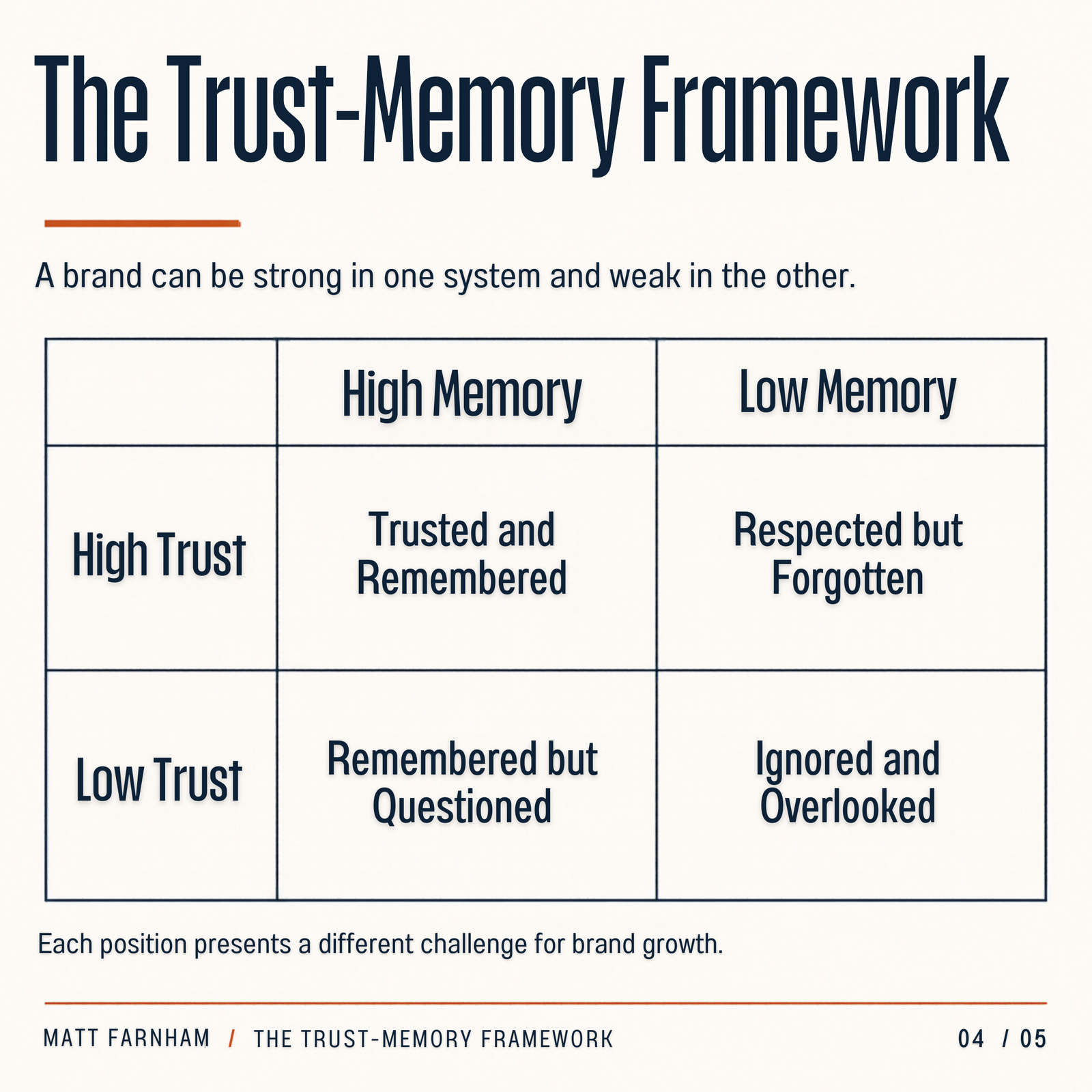
A weak Memory System means a brand may be respected but forgotten. A weak Trust System means a brand may be remembered but questioned. The goal is not to choose between them. The goal is to design brand activity that strengthens both.
The framework can be understood as a matrix. The aim is the top-left quadrant: trusted and remembered, that is where brand advantage compounds.
High Memory | Low Memory | |
High Trust | Trusted and Remembered | Respected but Forgotten |
Low Trust | Remembered but Questioned | Ignored and Overlooked |
The Trust-Memory Framework is built around two connected systems. A Memory System makes a brand easy to notice, recognise and retrieve. A Trust System makes a brand credible, reliable and safe to choose.
A brand with high memory but low trust may be famous, distinctive or easy to recall, but struggle to turn attention into choice.
A brand with high trust but low memory may be well regarded by those who know it, but absent from too many buying situations.
A brand with low trust and low memory is both overlooked and unchosen.
The systems are distinct, but they often strengthen each other through consistency, repetition, familiarity, proof and reliable experience. The same sponsorship, campaign, content platform, service experience or distinctive asset can build both systems when it is deliberately designed to do so.
How brands can use this framework
The Trust-Memory Framework is useful because it changes the questions marketers need to ask themselves.
Instead of asking only, “How many people saw this?”, brands should ask:
- Does this strengthen memory? Will this activity make the brand easier to recognise, retrieve and recall in the future? Strong memory-building activities often reinforce distinctive assets, category associations, visual consistency and repeated exposure. They help customers recognise the brand quickly and retrieve it easily when a buying decision arises.
- Does this strengthen trust? Will this activity increase confidence in the brand's ability, reliability or credibility? Strong trust-building activities provide evidence. They demonstrate competence, reduce uncertainty, showcase customer outcomes and reinforce consistency between what a brand promises and what it delivers.
- Does this strengthen both? The most valuable activities often contribute to both systems simultaneously. A sponsorship can create repeated exposure while borrowing trust from a respected environment. Thought leadership can demonstrate expertise while building memorable associations. Consistent customer experience can reinforce reliability while creating lasting memories. These are the activities where trust and memory begin to compound.
Those three questions make the framework practical.
The Trust-Memory Audit
Before your next campaign, ask yourself:
- Are the brand’s distinctive assets clear?
- Are they used consistently?
- Are they correctly attributed?
- Is the brand building a connected system, or a collection of disconnected assets?
- Are category entry points being reinforced?
- Would the brand still be recognisable if someone only saw a colour, phrase, sound, shape or layout?
That matters because fragmented media punishes weak memory systems. People rarely experience the whole brand at once. They see pieces. The system needs to survive when partially seen.
The second step is to audit the Trust System.
- Is the brand giving people reasons to believe it?
- Is it proving its claims?
- Is it reducing uncertainty?
- Is the customer experience consistent?
- Is social proof visible?
- Is there third-party validation?
- Does the behaviour match the promise?
That matters because trust cannot be claimed into existence. It has to be earned, reinforced and made visible.
The third step is to look for activity that builds both.
- A sponsorship should not just buy visibility. It should create repeated exposure in an environment people already trust.
- Thought leadership should not just fill a content calendar. It should demonstrate expertise while giving the brand a clearer point of view to be remembered for.
- Customer experience should not just support retention. It should become evidence that the brand can do what it says.
- Distinctive assets should not just improve recognition. Used consistently over time, they can make the brand feel more established and familiar.
- Proof points should not just build trust. When repeated and attached to distinctive brand cues, they become part of the memory system.
That is where the best brands create an advantage. They do not build trust and memory separately; they build a system where the same signals keep doing both jobs. This becomes even more important in an AI-driven marketing ecosystem. Brands will be able to produce more than ever. More ads. More versions. More social posts. More landing pages. More tests. More messages. More campaigns.
But more content does not automatically create a stronger brand; it can create the opposite.
If every execution looks different, sounds different and makes a different promise, the brand may become harder to recognise over time. If the promise changes faster than the experience, the brand may also become harder to trust.
The point is not that brands should repeat themselves forever. Brands need to evolve. But the strongest brands are disciplined about what they allow to accumulate. They know which cues need to keep building memory. They know which behaviours need to keep proving trust. Because memory without trust can make a brand famous for the wrong reasons. Trust without memory can leave a brand respected but absent.
Memory gets a brand considered. Trust gets a brand chosen. The best brands do both.
Matt Farnham is an award-winning senior marketing leader with more than a decade of experience in brand, communications and customer engagement. His work has focused on helping organisations build trust, strengthen customer relationships and drive sustainable growth, particularly in highly regulated industries. In 2024, he was named Future Leader of the Year at the Australian Marketing Institute Marketing Excellence Awards. He writes about brand strategy, marketing effectiveness and customer behaviour at mattfarnham.au.
References
- Australian Communications and Media Authority (2026). Communications and Media in Australia https://www.acma.gov.au/communications-and-media-australia
- Byron Sharp (2010). How Brands Grow. Oxford University Press.
- Principals x The Navigators (2026). Make it Unmistakable: A study of Australia’s most distinctive brands. https://www.principals.com.au/trend-presentation/make-it-unmistakable-2026-report/
- Robert Zajonc (1968). Attitudinal Effects of Mere Exposure. https://psycnet.apa.org/record/1968-12019-001
- Roy Morgan (2026). Bunnings is Australia’s most trusted brand. Telecommunications, led by Optus, is the most distrusted industry. https://www.roymorgan.com/findings/10157-risk-monitor-quartely-update-december-2025
- Hovland, C. I., & Weiss, W. (1951) The Influence of Source Credibility on Communication Effectiveness https://www.jstor.org/stable/2745952
- Alter & Oppenheimer (2009) Uniting the Tribes of Fluency to Form a Metacognitive Nation https://journals.sagepub.com/doi/10.1177/1088868309341564